Boldungu origin revealed as bold and adungu for fun

Today, let me answer the question that has been on the minds and lips of Boldungu users and competitors regarding the meaning of Boldungu. This uniquely African name is a creative combination of two words “Bold” and “Adungu”.  Our platform aims to be bold and decisive in leading the way mathematics should effectively be made easy, meaningful and natural for every learner.

While we aim to be bold in our design, delivery and learner engagement, fun for learners is never to be compromised. Adungu is a stringed musical instrument of the Alur people of northwestern Uganda that  is an arched harp of varying dimensions, ranging from seven to ten strings or more. The truly African music produced by the Adungu instrument and the way the Alur people enjoy adding is a constant reminder that fun must be constant in whatever we do.

In fact, bold and adungu is repetition because the design of the adungu instrument is uniquely bold. As described by wikipedia, the physical form of the adungu derives from uniquely African origins. The instrument is made of a hollowed-out slab of wood, which is covered by two pieces of leather, woven together in the center. The upper piece of leather functions as a soundboard, and a wooden rib supports it, serving also as a structure to secure the strings to the soundboard. A curved wooden neck, containing a tuning peg for each note, is inserted into the end of the instrument’s body. The strings run diagonally from the tuning pegs in the neck to the rib in the center of the body.

With Bold and adungu combining into Boldungu, our team must be extremely creative to deliver this ambition especially when we are shaping younger minds from primary 3 to primary 7 with mathematics, the language of science. Have fun with mathematics, practice makes perfect

Share Button

A tool to practice mathematics beyond homework

Most schools provide homework as means of drilling students for additional work. The homework model provides one-size fits all arrangement on the assumption that all learners are equal strength and competence and must do the same questions.

Because math homework is a daily event, they have become a ritual that learners must go through without much attention. Once the work is done and marked, that is the end of that task. The learners rarely engage their brains to remember what was covered in the work.

Usually the homework covers a specific topic that is related to what has just been taught by the teacher. So learners essentially go through routines that were covered earlier in class. This kind of learning promotes rote learning and learners try to build some kind of “reference table” in their heads mapping which routines were used on given day for a given homework.

When students are faced with mathematics problems, they try to remember which method they used in an earlier homework that should be applied. Learners should be able to internalize a problem and address it based on concepts and understanding as opposed to blind application of some routine used in in some homework Homework on the same topic fail to give learners the ability to see patterns in related problems that are unique from other problems. Within the school setting, it is very hard for a teacher to regularly given mixed homework because of the pressure to finish the syllabus, time needed to get every student at the same level, and the criteria to mix the homework will surely be biased.

There is need to give the power to the learners. Engage them to practice questions based on a robust tracking mechanism by keeping tabs on all the topics to be covered. Also there is need to separate concepts from general problem solving to ensure students recall and apply the concepts correctly to problems.

This kind of power can be provided by a good eLearning platform with tools to mix questions and provide detailed solutions to learners.

Share Button

6 Reasons parents say they like Boldungu to boost their children Mathematics Grades

Although many people see mathematics as a tool for doing calculations, it is a language for expressing logical thoughts, which is learned through reasoning and logic. Here are some of the reasons parents say they like boldungu.

  1. Creates positive change in the learning and teaching of mathematics
  2. Resource for parents to keep their children productively engaged while at home
  3. Creates a bond between the children and the parents when they practice together
  4. Provides good use of digital appliances such as tablets, computers and mobile phones at home
  5. Support for parents with skills on how to manage their children’s use of digital platforms.
  6. Provides remote tracking of learners activities and progress.

Start today at zero cost, and dare you child to dream! Find boldungu on Google play store

Share Button

Injecting fun into probability and chance for primary school mathematics

Many events happen in a random, unpredictable nature. The study of probability for primary school children in many countries including Uganda therefore forms a basis for understating nature. Probability is applied in many disciplines including statistics, meteorology, game theory and risk analysis among others

Many learners go through this topic without understanding its core nature which limits their understanding of many other branches of mathematics including set theory, infinity series/sequences and limit, chaos theory, noise and information theory and so on.

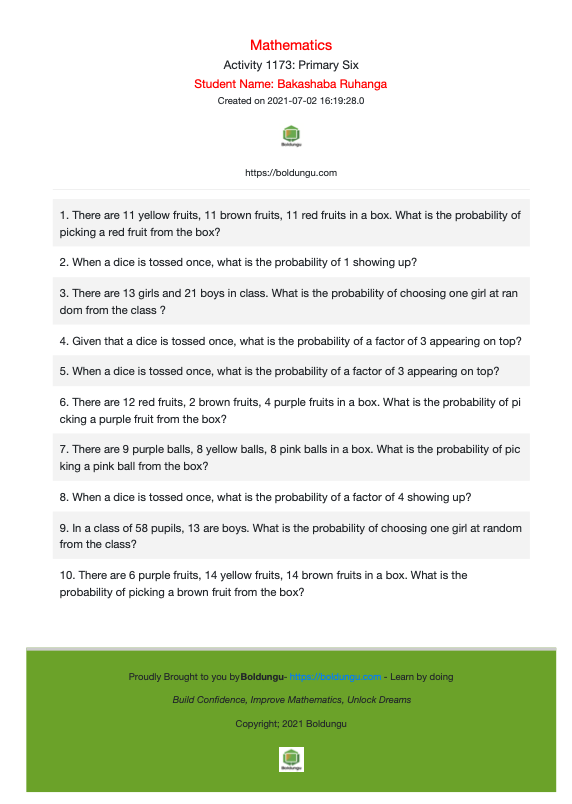
Boldungu has taken time to build a collection of relevant questions as per the Uganda curriculum for primary school mathematics, starting from primary 3 to primary 7 as illustrated below.

Complete with solution for learners to practice and understand the concepts, boldungus is determined to build dreams for learners.

Share Button

Number sense is the secret weapon for children that excel in mathematics

Many things that we take to be obvious are a result of mental modals that we build as a result of consistent exposure. It is this lack of mental models that when a baby presented with two cakes will not be able to tell which one is bigger. This distinction becomes obvious as the baby gains more exposure. The ability to quickly see solutions based on persistence exposure to numbers and mathematics is what we call number sense. It is number sense that you use to estimate the number of people in a room without counting. It is number that engineers use to tell the distance between two points without measuring!

Most babies will not tell which piece of cake is bigger due lack of number sense

Number sense comes with experience; just like a good footballer knows where the goal is even when he is facing the opposite direction. Many patterns exist in numbers and come naturally after continuous practice. For instance, the reason why most people will quickly workout ten minus four to be six (ie 10 – 4 = 6) is because they have developed a number sense for sums of ten.

It is number sense that a shopkeeper uses to workout balances and prices at the blink of an eye. Classroom mathematics, children spend much of their time dividing, adding, multiplying and subtracting. A learner with good number sense will accurately complete these tasks in a much shorter time.

Just like the shopkeeper gains number sense for counting money quantities, it is what learners with continuous exposure to mathematics do for classroom mathematics. Multiples of numbers, factors, remainders, reciprocals, halves, squares and many more mathematics concepts can all be part of a learner’s number sense with practice.

Good number sense cannot be gained by using standard print textbooks, because a learner can easily exhaust all questions at the end of the chapter without much variability. This limitation with print textbooks is similar to that of an adult that has been exposed to limited environments. Digital learning tools are very handy in building robust number sense.

Share Button

5 (Five) Main reasons why primary school children continue to fail mathematics – Boldungu can fix some

“A Problem Well Stated is Half Solved”. These words by Charles Kettering, who was head of research at General Motors from 1920 to 1947, are still valid. Mathematics remains an uphill task for learners, teachers and countries because it has a direct impact on the economy in terms of future of work and innovations.

In Uganda, Primary Leaving Examination (PLE) released by UNEB do no lie. A few highlights

Here are some of the reasons from the boldungu data analytics

  1. Inability to understand the right concept – our data shows that students struggle to understand concepts. For instance decimal number system is built on simple groups of ones, and tens. When dealing with other number systems such as binary, the grouping just changes to ones and twos. Alas, most students will apply all mechanical means to remember each number system separately and this does not scale.
  2. Failure to understand the meaning of symbols – mathematics is about problem solving, and stating the problem using symbols is one way of making it precise. Good mastery of symbols is challenge for many learners and we have seen learners fail the same question when presented differently using different symbols
  3. Inability to understand the root of principles – strong connection between mathematics and the learner can only be created if the underlying principle resonates with the learners. Here cost price, selling price, profit and loss are the most obvious examples. Many learners have been given the formula to get the profit, and loss but find it hard to apply the simple principle that if you buy and sell at lower value, you loose money or if you buy and sell and high price you gain. We have seen many cases where learners are just eager to add or subtract values with no regard to underlying principle. Alter the question a bit, and the formula fails to work.
  4. Lack of fluency in using operators and procedures – Application of operators to process problems is a must have skill to excel in mathematics. For instance, reducing fractions, expanding numbers and many other concepts largely play around with operators.
  5. Lack of comprehensive knowledge – concepts in mathematics relate to each other. We have seen situations where students think about mathematics in terms of islands. A student will fail to arrive at the final result by applying say long division because he or she thinks long division must be used only when asked to use it.

As said “A Problem Well Stated is Half Solved”, and that is how boldungu design principles came into action. Some call it a game, and others call it real mathematics. Whatever it is, our target remain the same – deal with the inherent challenges low grades in mathematics at national examinations, poor application of mathematics in real life, and long term applicability.

Share Button

Turn mathematics problem solving for primary school children into a conversation

Vocabulary is the body of words one can use effectively to communicate in a given language. Our research shows that learners in lower classes find difficulty in using common mathematics words such as “altogether”, “diameter”, “profit” and many others, which makes it impossible for them to workout the correct answers.

This inadequacy in mathematics vocabulary can only be addressed through regular practice by putting new words into writing and speaking so that learners continue to remember them. Learners need to see many of these words in various contexts such that they become part of their daily vocabulary. Once this happens, then solving mathematics problems will be natural similar to responding to a conversation.

Students that excel in primary mathematics have better mathematics vocabulary and technology solutions can help. Concepts and vocaburary matter most.. Our research with several learners and teachers, shows that a good number of children just workout the numbers without understanding or appreciating what they are trying to achieve.

Let us take an example from our study when we requested learners to show what 90 degrees means from the geometric diagrams they were using in their homework’s. Although well drawn with the 90 degrees mark, most learners were oblivious of the fact that an angle is the amount of turn between two lines. Some suggested that 90 degrees was a distance along the vertical and horizontal lines.

From the learning point of view, it is okay for learners to start by working out the numbers as this is in line with booms taxonomy of learning. However, without appreciating the underlying concept of an angle as the amount of turn, upstream concepts such as alternate angles, complementary angles, supplementary angles, interior/exterior angle properties of triangle become confusing and artificial because of the inability to relate them to real-world meaning.

Without any relation among the terms and terminologies, learners resort to rote learning or the try and error method where they will simply look at the numbers and either add, multiply or do whatever they can recall the teacher doing to numbers in class. This undesired state of affairs can be mitigated by allowing learners to do more directed practice on specific questions that seek to reinforce a linkage to real-word meaning.

Boldungu draws from the well-known psychology stimuli-response where repeated exposure and reinforcement will lead a natural linkage to concepts. Learners get to create questions for themselves. This first and foremost gives the learners the notion that it is no the teacher against them by firing questions at them, but it is them exploring the world of mathematics.

Share Button

Engaging Probability Activities for School Children

As parents, we’re always on the lookout for creative ways to enhance our children’s learning experiences, especially when it comes to subjects like math. Probability, a fundamental concept in mathematics, doesn’t have to be confined to the classroom. With a bit of imagination and some everyday materials, you can introduce your child to the fascinating world of probability right at home or outdoors. Let’s explore five engaging activities that make learning probability fun and memorable for kids!

  1. Coin Toss Challenge: Using simple coins, embark on a coin toss challenge with your child. Have them predict whether the coin will land heads or tails and record the outcomes. This activity not only introduces the concept of equally likely events but also sparks conversations about probability in everyday situations.
  2. Bean Jar Experiment: Gather some beans or grains and a jar to conduct a bean jar experiment. Fill the jar with beans of different colors and have your child pick out beans without looking. By recording the colors and analyzing the results, kids gain hands-on experience with probability while enjoying a tactile activity.
  3. Rock, Paper, Scissors Tournament: Turn the classic game of Rock, Paper, Scissors into a probability lesson! Keep track of wins and losses as you play with your child. Discuss the likelihood of winning with each choice and explore the concept of probability through this interactive game.
  4. Counting Game with Seeds: Utilize seeds, small containers, and your child’s estimation skills for a counting game. Fill containers with varying numbers of seeds and have your child guess the quantity in each. This activity not only reinforces counting skills but also introduces the concept of probability through practical estimation exercises.
  5. Outdoor Dice Roll: Take learning outdoors with a homemade dice made from cardboard. Roll the dice on the ground and have your child predict the outcome before each roll. By recording and analyzing the results, children gain insights into probability while enjoying the fresh air and active play.

These activities are not only educational but also easy to implement with materials commonly found at home or in local markets. By incorporating hands-on experiences and real-life scenarios, parents can ignite their child’s curiosity and enthusiasm for probability, paving the way for a lifelong love of math.

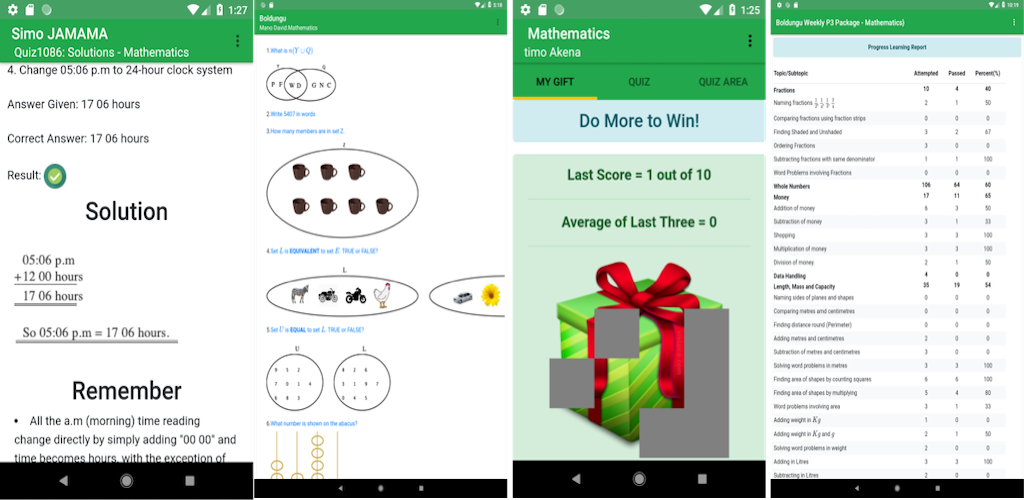
Looking for more interactive learning experiences? Explore our math mobile app, where kids can delve deeper into probability and other mathematical concepts through engaging games and activities. With the right tools and a sprinkle of creativity, learning math becomes an exciting adventure for children of all ages!

Let’s make math fun and accessible for every child, one engaging activity at a time!

Share Button

Interactive Activities to Master Fractions with Ease

Fractions can sometimes seem like a daunting concept for kids, but with the right approach, learning about fractions can be both enjoyable and rewarding. Through interactive activities that incorporate everyday objects and playful games, children can develop a deep understanding of fractions while having fun. Let’s explore five engaging activities that will help your child master fractions with ease!

  1. Pizza Party Fraction Fun: Transform pizza slices into a delicious lesson on fractions! Use a real or drawn pizza and divide it into slices. Have your child identify and label the fractions represented by each slice. For an added twist, let them create their own pizza with different toppings and divide it into fractions.
  2. Fractional Fruit Salad: Get creative in the kitchen with a fractional fruit salad activity. Select various fruits and cut them into different-sized pieces. Encourage your child to combine the fruits in bowls and express the fractions of each fruit in the salad. This hands-on approach makes learning fractions tasty and memorable.
  3. Fraction Bingo: Turn learning fractions into a thrilling game of Bingo! Create Bingo cards with fractions instead of numbers. Call out fractions, and your child can mark the corresponding fractions on their card. This game not only reinforces fraction recognition but also adds an element of excitement to learning.
  4. Fractional Art Projects: Unleash your child’s creativity with fractional art projects. Provide materials like paper, scissors, and colored markers or paints. Have your child create art pieces such as collages or paintings, incorporating fractions by dividing shapes or sections of their artwork. This activity combines artistic expression with mathematical learning in a fun way.
  5. Fractional Relay Race: Take fractions outdoors with a fractional relay race. Set up stations with different fractional tasks, such as hopping a certain fraction of the way to a marker or filling buckets with a fractional amount of water. Children can work in teams to complete the tasks, reinforcing their understanding of fractions while enjoying active play.

These interactive activities offer engaging ways for children to explore and master fractions while developing critical math skills. By incorporating fractions into everyday experiences and playful games, learning becomes not only accessible but also enjoyable.

Looking for more ways to reinforce fraction concepts? Dive into our math mobile app, where children can access a variety of interactive games and exercises designed to make learning fractions a breeze. With the right tools and a sprinkle of creativity, children can conquer fractions with confidence and enthusiasm!

Let’s make fractions fun and accessible for every child, one interactive activity at a time!

Share Button

Five Engaging Activities to Master Addition Skills

Addition lays the foundation for mathematical understanding and is a crucial skill for children to develop. By making addition fun and interactive, kids can build confidence and fluency in this fundamental operation. Let’s explore five engaging activities that will help your child master addition skills while having a blast!

  1. Counting with Coins: Turn pocket change into a valuable learning tool! Gather coins of different denominations and encourage your child to count and add them up. Create simple addition problems using the coins and have your child solve them. This hands-on activity not only reinforces addition skills but also introduces the concept of money.
  2. Math Treasure Hunt: Transform learning into an exciting adventure with a math treasure hunt. Hide objects around the house or yard and label each hiding spot with a number. Provide addition problems that lead to the next clue or hidden treasure. This activity not only reinforces addition skills but also promotes problem-solving and critical thinking.
  3. Number Line Jump: Create a makeshift number line using tape or chalk on the floor. Call out addition problems, and have your child jump to the correct sum on the number line. For example, if the problem is 3 + 2, your child would jump to the number 5. This active and kinesthetic approach makes addition practice dynamic and engaging.
  4. Cooking Creations: Get cooking in the kitchen and combine addition with delicious recipes! Choose simple recipes that involve measuring and combining ingredients. Encourage your child to follow the recipe and add up the ingredient quantities. This real-world application of addition skills makes learning practical and enjoyable.
  5. Addition Bingo Bash: Spice up addition practice with a game of Addition Bingo! Create Bingo cards with sums instead of numbers. Call out addition problems, and your child can mark the corresponding sums on their card. This game adds an element of excitement to addition practice while reinforcing fluency and accuracy.

These interactive activities offer engaging ways for children to practice and master addition skills while having fun. By incorporating addition into everyday experiences and playful games, learning becomes not only accessible but also enjoyable.

Looking for more ways to reinforce addition concepts? Dive into our math mobile app, where children can access a variety of interactive games and exercises designed to make learning addition a breeze. With the right tools and a sprinkle of creativity, children can become addition experts with confidence and enthusiasm!

Let’s make addition fun and accessible for every child, one engaging activity at a time!

Share Button